
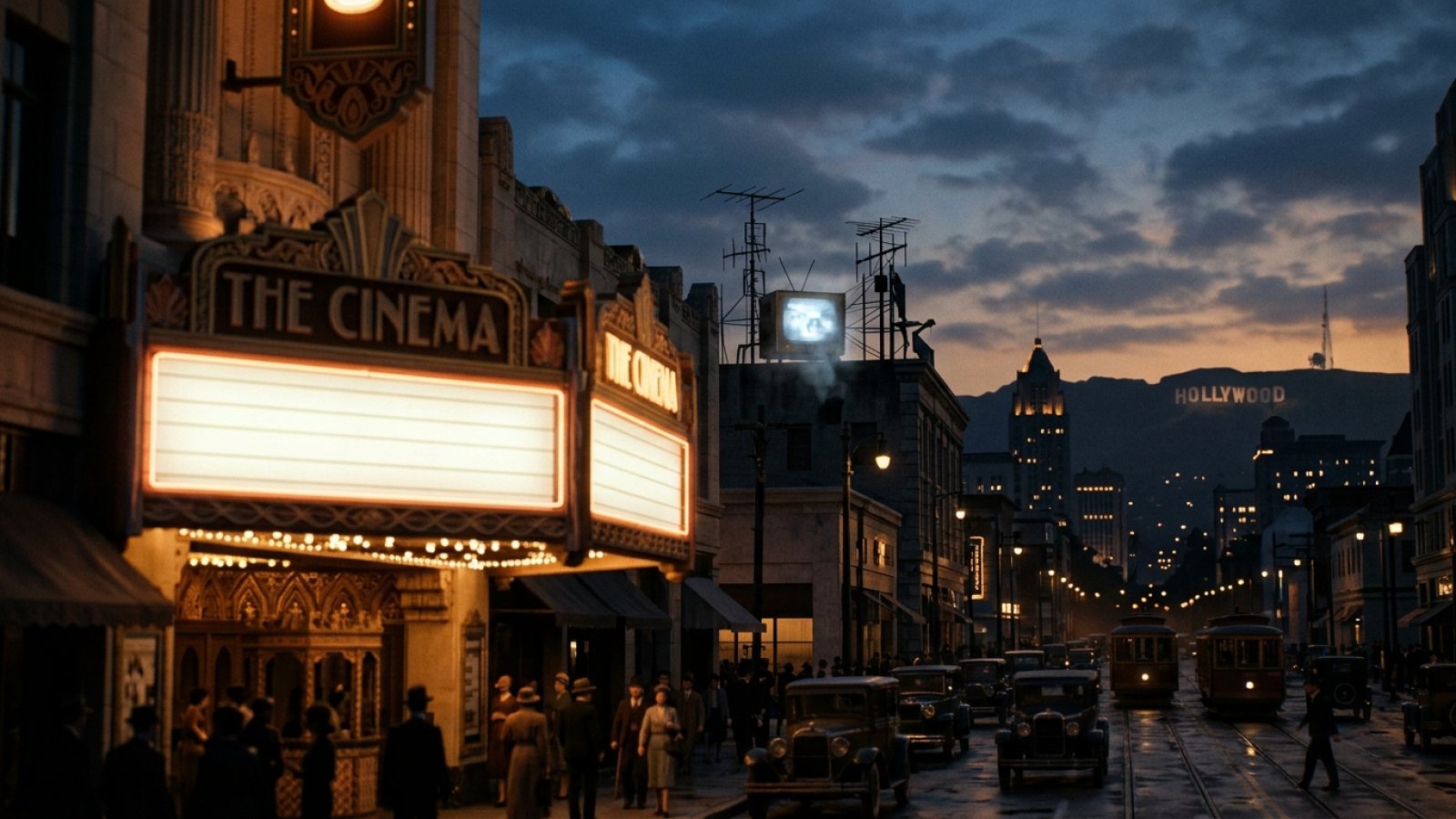
1927: The Year Sound Shook Cinema, Television Flickered, and an Industry Formalized
In 1927, three distinct threads of progress converged, fundamentally reshaping how the world would consume stories and information. The arrival of synchronized sound in film, the first public long-distance demonstration of television, and the formal organization of Hollywood's elite collectively signaled a profound shift in media's future.
The year 1927 stands as a singular crossroads, where the nascent pathways of mass entertainment and communication converged and diverged, setting the stage for the next century of cultural consumption. A technological leap in cinema, a flicker of future possibility in broadcasting, and the strategic formation of an industry's governing body all transpired, each moment a crucial pivot point that would resonate for decades.
The Sound Revolution: Cinema Finds Its Voice
For more than three decades, the magic of motion pictures had been a silent one, relying on orchestral accompaniment and intertitles to convey narrative. That changed decisively on October 6, 1927, with the premiere of Warner Bros.' The Jazz Singer. Starring Al Jolson, the film was not entirely a 'talkie,' but its segments of synchronized dialogue and music, delivered via the Vitaphone sound-on-disc system, proved to be an overwhelming sensation. The crackle of Jolson's voice, declaring, “You ain’t heard nothin’ yet!” was not merely a line of dialogue; it was a prophecy and a declaration of war on silent film.
This event marked a profound cause across the Cinema, Music, and Tech timelines. Technologically, it ushered in an era of unprecedented innovation in sound recording and projection, rapidly rendering silent film cameras, studios, and projection equipment obsolete. For Music, it forged an unbreakable link with cinema, transforming film scores and popular songs into global phenomena. Musicians and composers became integral to film production, and the film industry suddenly possessed an immense new platform for musical distribution. The transition was costly and disruptive, but the public's appetite for talking pictures was undeniable, forever altering the art and business of filmmaking.
The Flicker of Tomorrow: Television's Debut
While audiences flocked to hear Al Jolson sing, another, far less celebrated, but equally revolutionary technological demonstration took place on April 7, 1927. Bell Telephone Laboratories, under the direction of Herbert E. Ives, publicly demonstrated the first long-distance transmission of television in the United States. The broadcast, from Washington D.C. to New York City, featured the image and voice of then-Secretary of Commerce Herbert Hoover, who addressed an audience of reporters and scientists on a small, grainy screen. The Bell system used mechanical scanning. That September, in San Francisco, Philo Farnsworth transmitted his first image with an all-electronic camera tube, the line that television would eventually follow. Together they showed the Tech timeline the potential for live pictures over vast distances.
The timing of this demonstration, in the same year as sound film's breakthrough, is a remarkable coincidence. While The Jazz Singer immediately transformed an existing industry, television was still decades away from mass adoption. Yet, this early public viewing of television laid the groundwork for a future medium that would eventually become a direct rivalry to cinema for audience attention, fundamentally altering patterns of leisure and information consumption. It was a quiet scientific achievement that, unbeknownst to most, pointed toward a future where moving images would enter private homes, forever changing the media landscape.
Forging an Industry: The Academy's Foundation
In a year of such dramatic technological shifts, the established film industry also took significant steps to formalize its structure and safeguard its interests. In May 1927, the Academy of Motion Picture Arts and Sciences (AMPAS) was incorporated and held its founding banquet. Founded by Louis B. Mayer, head of Metro-Goldwyn-Mayer, and other prominent industry figures, the Academy's initial purpose was not primarily to host glamorous awards ceremonies, but to mediate labor disputes, promote cooperation among the studios, and foster professional excellence within the rapidly expanding motion picture business.
The establishment of AMPAS was a direct cause in the Cinema timeline for the professionalization of the industry, creating a body to standardize practices, recognize artistic and technical achievements, and manage its public image. It also served as an echo in the Politics timeline, reflecting broader trends of industrial organization and self-regulation in an era of growing corporate power and labor movements. The Academy provided a unified voice for the studio system, allowing it to navigate the complexities of sound technology adoption, evolving censorship standards, and economic pressures. It created an institution that would, in time, become synonymous with Hollywood itself, establishing the criteria for cinematic merit that would shape global film culture.
The convergence of these events in 1927—the undeniable roar of synchronized sound, the nascent flicker of television, and the measured, strategic formation of the film industry's leading institution—created a unique crucible of change. Together, they did not merely update existing forms of entertainment; they inaugurated entirely new paradigms for how technology, art, and commerce would intertwine to shape human experience.
