
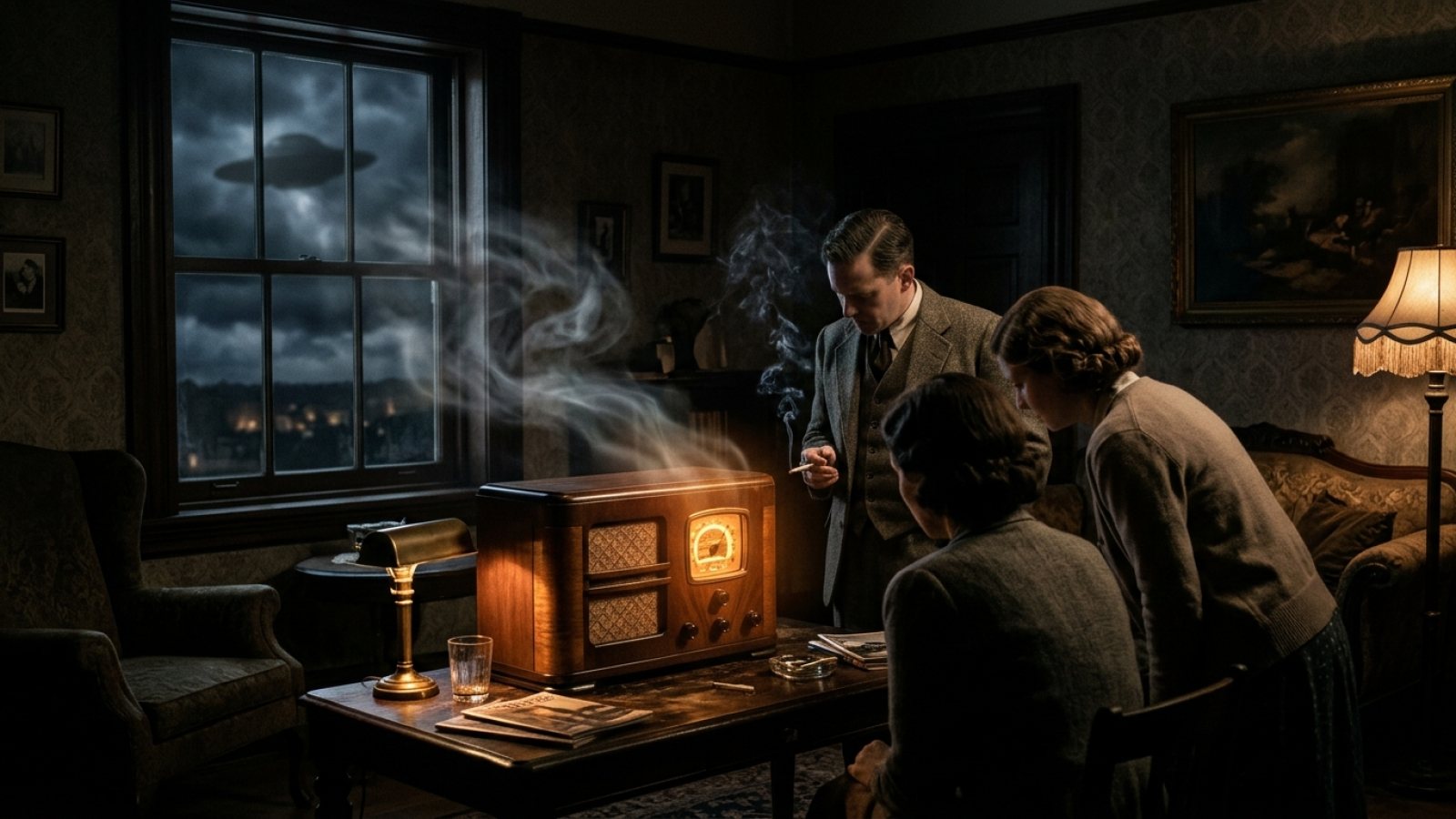
1938: The War of the Worlds Broadcast, Where Radio, Sci-Fi and a Nervous World Collided
On October 30, 1938, a radio drama set off reports of panic across parts of America, revealing the potent blend of emerging technology, speculative fiction, and widespread societal anxiety. This single broadcast illuminated the power of a nascent medium and the fragility of public calm on the eve of global conflict.
On October 30, 1938, as shadows lengthened across a world teetering on the brink, a radio broadcast from New York City delivered an hour of fiction that echoed the anxieties of a generation. Orson Welles and the Mercury Theatre on the Air presented an adaptation of H.G. Wells’s classic novel, The War of the Worlds, but with a twist: it was delivered in the format of breaking news bulletins, interrupting a fictional music program. This audacious artistic decision created a seismic intersection of three distinct timelines: the burgeoning power of radio, the enduring allure of science fiction, and the profound political instability of a world bracing for war.
The broadcast’s effect was a confluence, where advancements in communications technology, the imaginative reach of speculative fiction, and the underlying tension of international politics converged to create a unique social phenomenon. The widespread reports of panic, though later debated in their scale, undeniably highlighted the immense power radio had gained in American homes, and how susceptible a populace could be when that power was wielded with convincing realism.
The Unprecedented Voice of Radio
By 1938, radio had cemented its place as the primary source of instant information and entertainment for millions of Americans. Unlike newspapers or newsreels, radio offered real-time reports, bringing events from around the world directly into living rooms with unprecedented immediacy. Presidents used it for fireside chats, and news anchors relayed pivotal developments from Europe. This gave the medium an unparalleled authority, establishing a deep trust in its voice. Orson Welles and his Mercury Theatre company understood this implicitly. Their adaptation of The War of the Worlds leveraged this trust by abandoning traditional dramatic cues, presenting the Martian invasion not as a play, but as a series of urgent, increasingly frantic news flashes. This was a direct cause of the broadcast's impact on the public.
The program began innocently enough, introduced as a dramatic presentation, but quickly shifted. A fictional announcer cut away from a musical interlude to report strange explosions on Mars, then later, a meteorite landing in Grovers Mill, New Jersey. With each subsequent ‘update,’ the reports grew more terrifying: strange creatures emerging from a cylinder, destroying homes, and unleashing deadly heat rays and poison gas. The simulated field reports, complete with sound effects of crowd hysteria and military action, were designed to sound utterly authentic, mimicking the real-time reporting style to which listeners had become accustomed.
Martian Invasion, Earthly Fears
H.G. Wells’s original 1898 novel was itself a powerful work of science fiction, a cautionary tale reflecting British anxieties about invasion and the ethics of colonialism. By 1938, however, the global political landscape provided a far more volatile context for a story of alien invasion. The spectre of war hung heavy over Europe. Adolf Hitler’s expansionist ambitions had just won him the Sudetenland, handed over under the Munich Agreement signed at the end of September, and the continent was in a state of high alert. Reports of mass mobilizations, new weapon technologies, and the devastating potential of aerial bombings and chemical warfare were constant features of news cycles.
This backdrop of pervasive fear was a crucial echo that amplified the broadcast’s effect. Listeners, already primed for catastrophic news, found the fictional invasion reports eerily congruent with their deepest anxieties. Rumors of German U-boats, gas attacks, and sudden, overwhelming military aggression were not abstract concepts; they were the daily currency of international discourse. The fictional Martian heat rays and poison gas mirrored the grim realities of modern warfare that people genuinely feared. The broadcast, therefore, did not create panic from nothing, but rather tapped into a pre-existing reservoir of societal dread, offering a familiar narrative structure—invasion from an unexpected, powerful enemy—to explain the terrifying events unfolding in Europe.
A Crossroads of Credibility
The aftermath of the broadcast was swift and dramatic. Newspapers, many of which had been competing with radio for public attention, seized on stories of widespread panic, illustrating the immediate rivalry between media. While the true extent of mass hysteria has been debated by historians and media scholars, there is no doubt that numerous individuals and communities genuinely believed they were under attack. Switchboards at police stations and radio stations were jammed, and some people reportedly fled their homes.
The incident forced a critical examination of radio’s immense power and its responsibility. It highlighted the urgent need for clearer distinctions between news and drama, influencing broadcasting ethics for decades to come. More broadly, it served as a stark demonstration of how rapidly misinformation, even accidental, could spread through new technologies and how profoundly it could impact a public already gripped by global uncertainty. The “War of the Worlds” broadcast remains a singular moment where the medium truly became part of the message, altering how we understood the intersection of technology, narrative, and collective human psychology. It stands as a prescient warning about the power of media to shape reality, a lesson that continues to resonate into the present day.
