
1947: Where Flying Saucers, Transistors, and Hollywood Hearings Forged the Postwar Era
The year 1947 was a pivot point in history, a moment when the aftershocks of global conflict began to reshape the future in unexpected ways. Across disparate fields, new anxieties and technologies emerged that would define the second half of the 20th century.
The cessation of global war in 1945 did not usher in an era of simple peace. Instead, 1947 stands as a foundational year, a crucible where emerging technologies, political anxieties, and cultural shifts converged to forge the very character of the postwar world. It was a year defined by new frontiers: the infinite expanse of the sky, the microscopic world of electronics, and the ideological battlegrounds of Capitol Hill and Hollywood.
The Sky Awakens
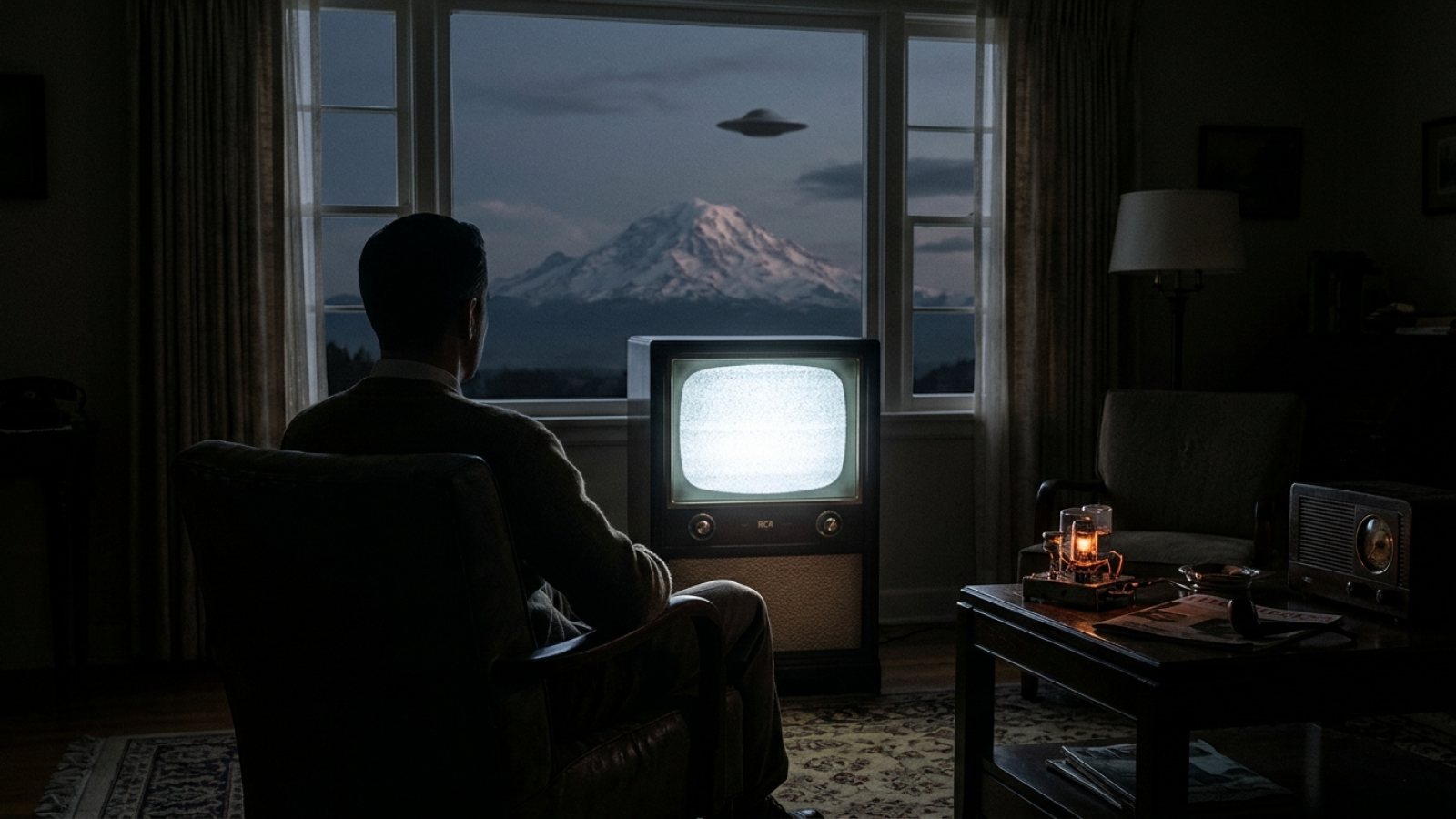
On June 24, 1947, a private pilot named Kenneth Arnold reported seeing nine unidentified objects flying at incredible speed near Mount Rainier, Washington. His description of their motion as like "saucers skipping on water" gave birth to the enduring term "flying saucers." This initial sighting, reported widely, opened the floodgates for similar claims across the United States. Just weeks later, in July, reports from Roswell, New Mexico, claimed the crash of a mysterious object, which the military initially identified as a "flying disc" before retracting to a weather balloon. The truth of what occurred remains debated, but the public imagination was irrevocably captured.
This surge of unidentified aerial phenomena was not merely a coincidence of dates; it was an echo of the nascent Cold War and the atomic age. People were keenly aware of advanced German rocket technology and the destructive power of the atomic bomb, fueling both a fascination with unknown, potentially hostile, technologies and a deep-seated anxiety about the vulnerability of the nation's skies. The UFO timeline began its public trajectory here, intertwined with a growing sense of geopolitical unease and an evolving understanding of technology's double edge. It was a cultural touchstone that both reflected and amplified the era's pervasive sense of the unknown.
The Silent Revolution
While the skies above were generating headlines, a quiet, profound revolution was underway in the laboratories of Bell Telephone. On December 16, 1947, John Bardeen and Walter Brattain, under the direction of William Shockley, demonstrated the first working point-contact transistor. This tiny device, barely larger than a pencil eraser, was poised to replace the bulky, power-hungry vacuum tube that had powered all electronics since the early 20th century. The transistor promised unparalleled miniaturization, efficiency, and reliability.
The invention of the transistor was a technological cause with far-reaching consequences that would ripple through almost every other timeline. Though its immediate impact was not felt by the public in 1947, it laid the groundwork for the entire digital age. This was no mere coincidence of dates; the transistor was a fundamental technological shift that would enable everything from portable radios that put popular music in every teenager's pocket to the microprocessors that power modern computing, film special effects, and sophisticated military guidance systems. Its birth signaled a new era where power and complexity could be contained within ever-smaller packages, fundamentally altering how we live, communicate, and create.
Hollywood's Crucible
In October 1947, another kind of anxiety played out in the halls of Congress. In Washington, the House Un-American Activities Committee (HUAC) opened hearings into Hollywood, intent on investigating alleged Communist infiltration of the film industry. Witnesses, including prominent figures from the entertainment world, were questioned about their political affiliations and those of their colleagues. These hearings, characterized by aggressive questioning and accusations, marked a decisive escalation of the Cold War's ideological battles on American soil.
The Hollywood Hearings were a direct political cause with devastating effects on the Cinema timeline. They led directly to the blacklisting of writers, directors, and actors who refused to cooperate, effectively ending careers and instilling a climate of fear and self-censorship that permeated filmmaking for decades. The once vibrant and often socially conscious output of Hollywood became wary of controversy, impacting storylines, character development, and the very types of stories deemed safe to tell. This chilling effect was a stark reflection of the broader political tensions gripping the nation, demonstrating how deeply state power could intrude upon artistic expression and individual liberty.
The year 1947 was not simply a collection of events; it was a pivot, a moment where the future began to assert itself in new and often unsettling forms. The anxiety of unknown objects in the sky, the quiet promise of a tiny electronic component, and the public drama of political purges in the heart of the entertainment industry all converged to define the nascent postwar era, setting in motion forces that would reshape technology, politics, and culture for generations to come.
