1969: The Moon, Woodstock, ARPANET, and Monty Python — The Year Everything Went Live
In 1969, humanity made its first steps on the Moon, a generation gathered at Woodstock, the internet's precursor flickered to life, and a new brand of comedy hit the airwaves. This year marked a pivot, fundamentally changing how the world communicated, experienced, and understood 'live' events.
Few years in human history have converged so many disparate yet profoundly influential moments as 1969. It was a year when the concept of 'live' exploded across multiple facets of culture, technology, and politics, not merely as a broadcast event, but as an immediate, shared experience that reshaped how societies connected and understood their place in a rapidly changing world.
The World Watched Live: Apollo 11 and the Moon
On July 20, 1969, millions across the globe paused, eyes fixed on television screens, as Neil Armstrong stepped onto the lunar surface. The live broadcast of the Apollo 11 mission was an unprecedented feat, a culmination of decades of scientific ambition and Cold War rivalry. This event crossed the timelines of Tech, Politics, and Sci-Fi in a singular, defining moment. The massive Saturn V rocket and the intricate Lunar Module represented a pinnacle of aerospace engineering and computing, a technological cause that enabled humanity's journey beyond Earth. Politically, it was a profound victory for the United States in the Space Race, fulfilling President John F. Kennedy's audacious promise and asserting American dominance on the global stage. For generations, the idea of human spaceflight had been the realm of science fiction, and its live realization offered a powerful echo, transforming speculative imagination into tangible reality. The global satellite network, itself a marvel of communications technology, delivered this 'live' moment directly into homes, forging a universal human experience that transcended borders and ideologies.
A Generation Lived Live: Woodstock and the Counterculture
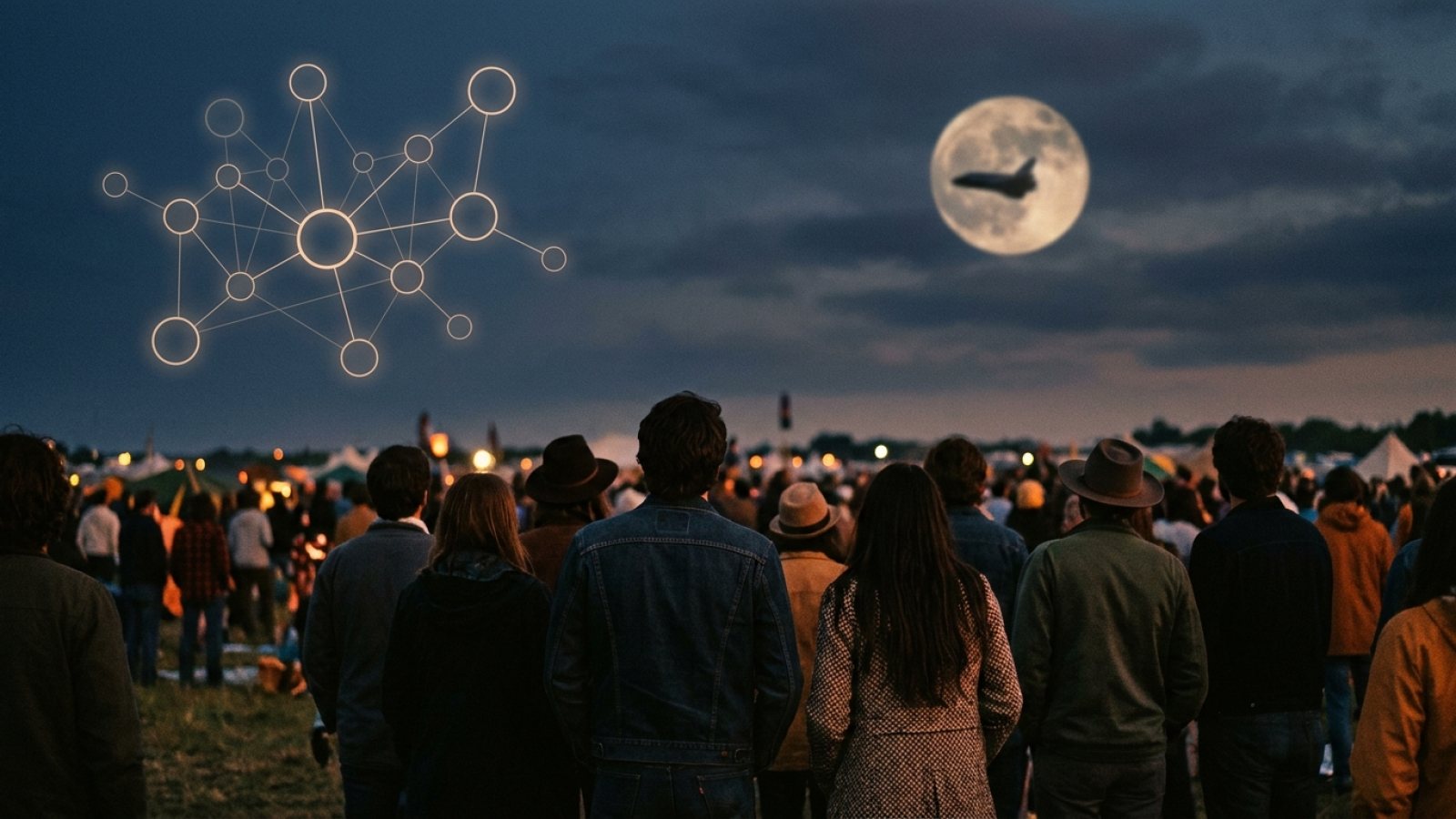
Just weeks later, in mid-August, another 'live' event captured the world's attention, albeit in a radically different context. The Woodstock Music & Art Fair in Bethel, New York, gathered an estimated 400,000 young people for three days of peace, love, and music. This monumental festival was a powerful crossing of the Music, Politics, and Tech timelines. As a musical phenomenon, it defined a generation, cementing the status of rock and folk artists and becoming an indelible symbol of the counterculture. Politically, Woodstock was a tangible echo of widespread disillusionment with the Vietnam War and a fervent call for social change, a massive, spontaneous demonstration of alternative values. Technologically, the event pushed the boundaries of live sound reinforcement for such a vast audience, and the initial footage captured by a massive film crew would later form the basis of Michael Wadleigh’s groundbreaking documentary, Woodstock (1970). While its aims and scale differed from the Moon landing, Woodstock was a vivid coincidence in a year defined by its immediate, collective experiences, embodying a generation's hopes and frustrations in real time.
The Future Went Live: ARPANET and the Dawn of Connectivity
As summer turned to autumn, a quieter, yet equally revolutionary 'live' moment unfolded in the hushed environments of university laboratories. In October 1969, the Advanced Research Projects Agency Network (ARPANET) successfully transmitted its first message between a computer at UCLA and another at Stanford Research Institute. This was a foundational crossing of the Tech, Politics, and Sci-Fi timelines that would redefine connectivity for the next century. ARPANET was a technological cause with political roots: it was funded by the Defense Department's research agency, a product of Cold War science budgets. It is often said to have been built to survive a nuclear attack; historians note that its immediate purpose was to let researchers share scarce, expensive computers, though survivable-network research did shape the packet-switching idea behind it. This early network, pioneering packet-switching technology, laid the groundwork for the modern internet. It was the first tangible echo of sci-fi visions of global information networks, where data could be shared instantly across vast distances, fundamentally altering the future of human communication and interaction. This 'live' connection, unseen by most, was a quiet hum that would grow into the roar of the digital age.
Comedy Went Live: Monty Python's Flying Circus
Also in October 1969, an irreverent and boundary-breaking new series premiered on British television: Monty Python's Flying Circus. This show marked a significant crossing of the Comedy, Tech, and Cinema timelines. It was a cultural coincidence, airing in the same intense month as ARPANET's debut, yet delivering a different kind of 'live' impact. On the comedy timeline, Python's sketches were revolutionary, abandoning traditional punchlines and narrative structures, often presenting surreal non-sequiturs that challenged audiences to rethink what television comedy could be. Technologically, television was the immediate medium, bringing this fresh, unpredictable humor directly into homes. Its influence would echo for decades, with many of its members going on to shape British comedy in cinema. Monty Python's Flying Circus demonstrated that 'live' wasn't just about global events or technological firsts, but also about the immediate, unpredictable shock of the new in culture, broadcast directly to an audience ready for something different.
1969 was a year that pulsed with immediacy, where the boundaries of possibility were pushed, and the world was brought together, or challenged, by events unfolding in real time. From the monumental achievements beamed from space to the nascent whispers of a global network, and from the roar of a festival crowd to the absurd laughter from a television screen, 1969 demonstrated how powerfully 'live' experiences could shape the course of history, setting in motion conversations and connections that continue to reverberate today.
